NFL Bet Builder in the UK: Constructing Same-Game Multis
 Available in US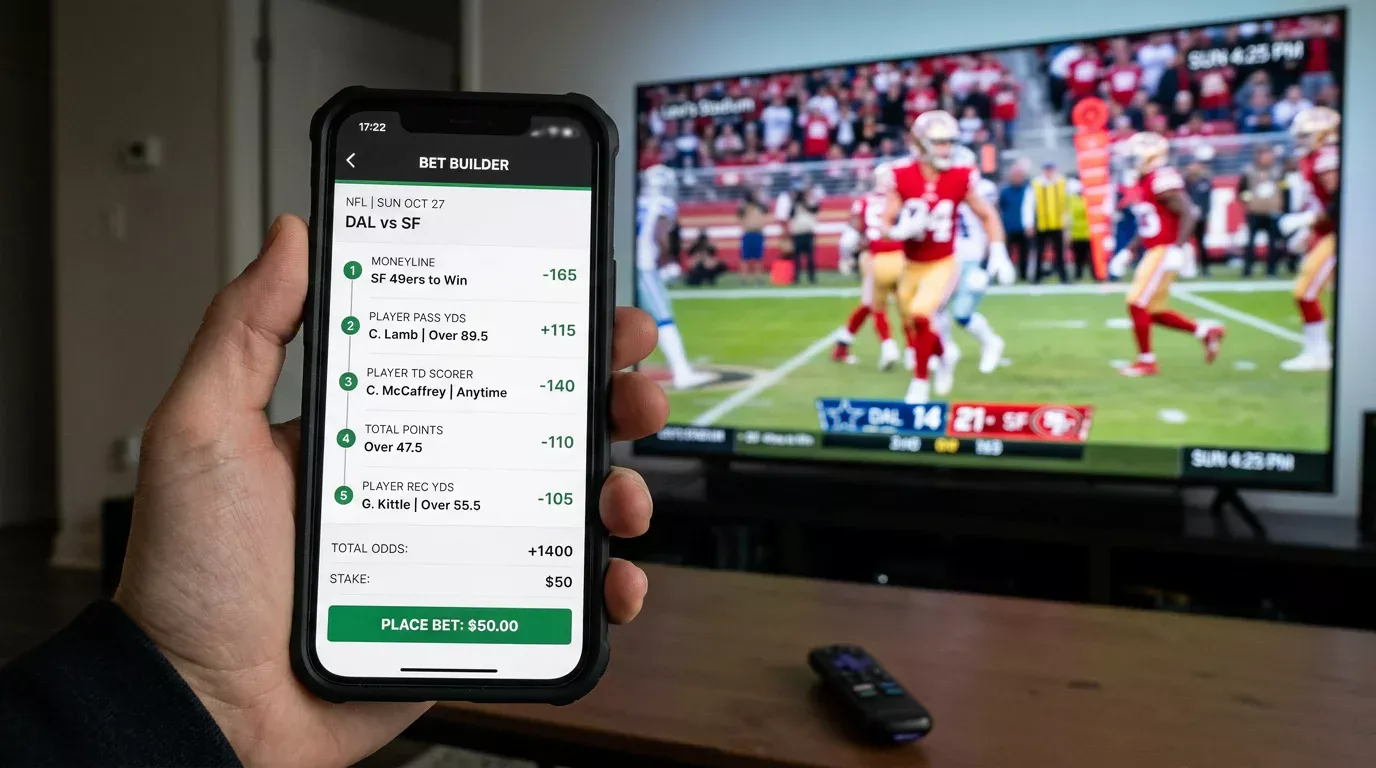
The bet builder changed how I approach NFL Sundays. Instead of placing three separate bets on the same game — a spread, a player prop, and a total — I can combine them into a single wager that only pays if all three hit. The payout multiplies. The risk does too. But the real reason bet builders have become my most-used NFL betting product isn’t the bigger number on the return line — it’s the ability to construct a bet that reflects a specific game narrative, not just isolated predictions.
Same-game multis, as they’re also called, let you build a thesis about how a game will unfold and put money behind that thesis as a single bet. You think the Chiefs will win comfortably, Patrick Mahomes will throw for over 280 yards, and the game total will go over? That’s a bet builder. Every UK bookmaker now offers some version of this product for NFL, and the market has matured significantly over the past two seasons — but the pricing mechanics and correlation traps still catch plenty of punters off guard.
Core Features of an NFL Bet Builder Tool
A few years ago, if you wanted to combine multiple selections from the same NFL game, you couldn’t. Traditional parlays required each leg to come from a different event. Bet builders changed that rule by letting you select multiple markets within a single game and combining them into one bet.
The concept is simple: choose two or more outcomes from the same NFL match — a team to win, a player to score, the total to go over — and the bookmaker prices the combination. Each selection is a “leg” of the bet builder, and all legs must win for the bet to pay out. The pricing reflects the combined probability of all outcomes happening together, adjusted for the bookmaker’s margin.
What makes bet builders different from standard accumulators isn’t just the same-game aspect — it’s the pricing engine. In a standard parlay, each leg’s odds are multiplied independently. In a bet builder, the bookmaker uses a correlation model to adjust the price. If two legs are positively correlated (a team winning and their star player scoring, for instance), the combined odds should be lower than simple multiplication would produce, because one outcome makes the other more likely. Whether the bookmaker’s correlation model accurately reflects reality is where the value — or the trap — lies.
Step-by-Step: Building an NFL Same-Game Multi
Let me walk through an actual build I’d consider for a Sunday afternoon game. Suppose the Buffalo Bills host the Miami Dolphins, with the Bills favoured by 4 points and the total set at 49.5.
My thesis: the Bills will dominate time of possession through their running game, win by more than a touchdown, and the game will stay under the total because the Dolphins’ offence will be on the field for fewer possessions. That narrative translates into three bet builder legs: Bills -6.5 alternate spread, the game total under 49.5, and the Bills’ running back to rush for over 85.5 yards.
On most UK sportsbook apps, the process is: navigate to the Bills-Dolphins game, select “Bet Builder” from the market tabs, then add each leg. The interface shows you which markets are available for combination — not all markets qualify. After adding all three legs, the app calculates the combined price. Suppose it returns odds of 7/2. A ten-pound stake returns 45 pounds including the original stake if all three legs land.
Before confirming, I run a mental check. Do the legs tell a coherent story? Is the narrative internally consistent? If I’m betting the under on the total, does it make sense to also include a player to score multiple touchdowns? Probably not — high-touchdown games tend to correlate with overs. Internal consistency between legs is the most important filter in bet builder construction, and it’s one that most casual users skip entirely.
Correlation Traps: Legs That Hurt Your Value
Here’s where bet builders get genuinely dangerous for punters who don’t think carefully about how outcomes relate to each other.
Genius Sports holds the exclusive contract for distributing official NFL data through to Super Bowl 2030, and every bookmaker’s bet builder pricing engine relies on this data to model correlations between outcomes. But these models aren’t perfect, and sometimes they work against you in ways that aren’t immediately obvious.
The most common trap: combining a team to win with the game total to go over. These two outcomes are positively correlated (winning teams tend to score more, which pushes the total up), and the bookmaker’s pricing engine should reduce the combined odds to reflect that correlation. Most engines do. But here’s the subtlety — the degree of correlation varies by matchup. When a strong favourite is expected to win by building a large lead, the correlation between “favourite wins” and “over” is actually weaker than average, because blowouts often feature second-half garbage time or the winning team running out the clock. The pricing engine may not adequately capture this game-specific nuance.
The reverse trap is combining an underdog to cover with an under bet. These are negatively correlated in most game scripts — if the underdog is covering, the game is close, which tends to produce cautious play and lower scoring. But the correlation isn’t strong enough to make the bet builder consistently mispriced in your favour. You’re often paying for correlation that barely exists in practice.
My rule of thumb: if two legs feel intuitively connected, assume the bookmaker has already priced that connection into the combined odds. Look for legs where the connection is real but non-obvious — like a specific receiver’s yardage prop combined with game flow factors that the correlation engine might underweight. That’s where the genuine value in bet builders lives.
Which UK Bookmakers Offer the Best NFL Bet Builder?
I’ve used bet builder products across six different UKGC-licensed platforms during the past two NFL seasons, and the variation in quality is substantial. The differences fall into three categories: market availability, pricing competitiveness, and user experience.
Market availability determines how many legs you can choose from. Flutter Entertainment — the group behind several major UK-facing brands — reported $15.91 billion in revenue for 2025, and part of that investment flows into expanding bet builder coverage. The best platforms offer 30 to 50 combinable markets per NFL game, including player props, quarter-specific lines, and alternative spreads. Smaller platforms might offer 10 to 15. The more markets available, the more precisely you can construct your thesis.
Pricing is harder to evaluate because bet builders don’t have a “true” price to benchmark against — the correlation adjustments are proprietary. What I do is build the same bet across three or four platforms and compare the combined odds. I’ve found consistent differences of 15-25% in payout between the best and worst priced platforms for identical bet builder legs. That difference compounds over a season of bets and represents the single largest variable in whether your bet builders generate positive or negative long-term returns.
User experience matters more than you might think. NFL Sundays move fast — games start, halftime arrives, and you want your bet placed before kickoff, not halfway through the first quarter. An app that takes six taps to add a leg versus one that takes three will cost you time during the peak betting window. I’ve abandoned bet builders mid-construction on platforms where adding a player prop required navigating away from the main bet builder interface. The best apps keep everything within the same screen flow, allowing you to scroll through available markets and add legs without losing your selections.
One additional factor: some platforms cap the maximum payout on bet builders at a lower threshold than standard accumulators. Check the terms before placing larger-staked bet builders — a cap of 500 or 1,000 pounds on a potential 20/1 winner is something you want to know about in advance, not after you’ve hit.
What is the difference between a bet builder and a standard parlay?
A standard parlay combines selections from different games, and the combined odds are calculated by multiplying each leg’s odds independently. A bet builder combines multiple selections from the same game, and the bookmaker uses a correlation model to adjust the pricing. This means bet builder odds are not simply the product of individual odds — they account for how the outcomes relate to each other.
Can I use bet builders for NFL live betting?
Some UK bookmakers offer live bet builders that allow you to add legs during a game, though the market availability is typically narrower than pre-match and the pricing adjusts rapidly with game flow. Not all platforms support live bet builders for NFL, and the markets that are available in-play tend to be limited to broader outcomes like next team to score or quarter winners rather than detailed player props.
Written by the editors at Best bet for nfl.