NFL Betting Tax in the UK: Securing Tax-Free Winnings
 Available in US
When I explain to American friends that I pay zero tax on my NFL betting winnings in the UK, the reaction is always the same mixture of disbelief and mild resentment. In the United States, sports betting winnings are taxable income — federal tax applies, state tax often applies on top, and sportsbooks issue tax forms for payouts above certain thresholds. In the UK, the system works completely differently. Betting winnings are not income, not capital gains, and not subject to any tax whatsoever for the punter. It is one of the most significant structural advantages that UK bettors hold over their American counterparts, and it’s surprising how few British NFL punters fully understand why.
Preliminary duty and levy receipts from betting and gaming in the UK for the 2025/26 financial year (April to August) totalled £1,786 million — nine percent higher than the equivalent period a year earlier. That money comes from operators, not from punters. Understanding where the tax burden falls, and what it means for your NFL betting returns, is essential knowledge for any serious bettor.
HMRC Regulations on UK Sports Betting Winnings
HMRC’s position on gambling winnings is straightforward and has been consistent for decades: betting winnings are not taxable in the UK. This applies regardless of the amount, the frequency of your betting, or the type of bet. Whether you win £50 on an NFL spread bet or £50,000 on a Super Bowl futures wager, the tax treatment is identical — you owe nothing to the Exchequer.
The legal basis is simple. HMRC does not classify gambling winnings as income because they arise from chance rather than from employment, trade, or investment activity. Since betting is not a trade in the legal sense — it’s an activity where outcomes are uncertain by definition — the proceeds fall outside the scope of income tax, capital gains tax, and National Insurance contributions. This position was established long before online betting existed and has been reaffirmed through multiple HMRC guidance updates.
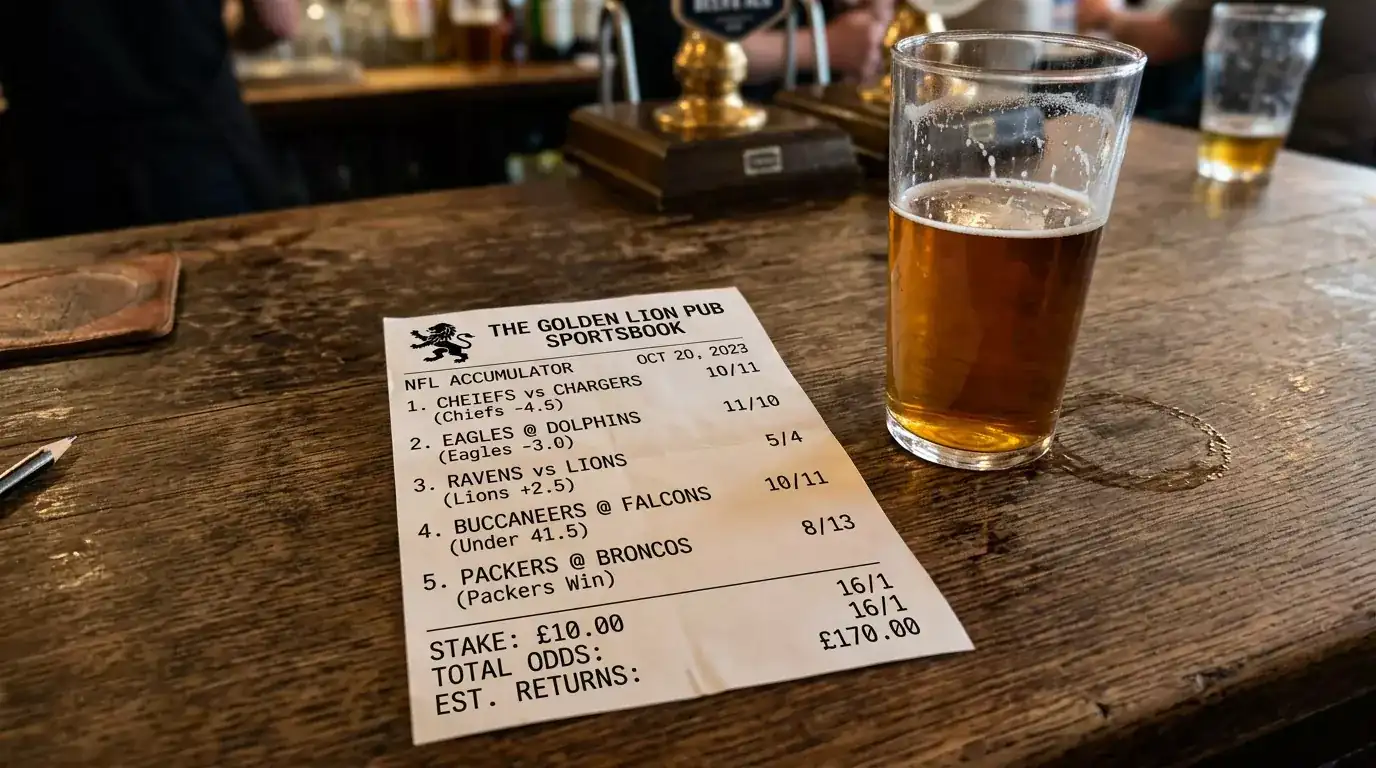
This extends to all forms of NFL betting available at UK bookmakers: spread bets, moneyline bets, parlays, prop bets, futures, in-play wagers, and exchange trading on platforms like Betfair. The method doesn’t matter, the amount doesn’t matter, and the sport doesn’t matter. A £10,000 return on an NFL accumulator is tax-free just as a £10 lottery win is tax-free.
The practical implication for NFL bettors is that your profit is your profit. When you calculate your return on investment over a season, you don’t need to discount for tax. A 5 percent ROI on your NFL betting is a genuine 5 percent return — not 5 percent before tax adjustments. As Andrew Rhodes, CEO of the Gambling Commission, noted in 2025, total gross gambling yield in the UK reached its highest-ever level at £15.6 billion, with participation remaining stable at 48 percent of the adult population. The tax-free status of winnings is part of what sustains that participation level.
UK vs US: How Tax Treatment of NFL Bets Differs
The contrast with the United States is stark and directly relevant to NFL betting economics. In the US, commercial sports betting revenue grew 22.8 percent in 2025 to nearly $17 billion, with total handle reaching $167 billion. American bettors who profit from that activity face a meaningful tax obligation.
Federal tax on gambling winnings in the United States applies at the bettor’s marginal income tax rate, which ranges from 10 to 37 percent depending on total income. Sportsbooks are required to issue a W-2G form for certain payouts — typically winnings of $600 or more at odds of 300-to-1 or greater — and the IRS expects bettors to report all gambling income regardless of whether a W-2G is issued. State taxes add an additional layer: in states like New York, combined federal and state tax on gambling winnings can exceed 50 percent for high earners.
Consider a practical example. An American bettor in New York who wins $10,000 on an NFL futures bet might owe $3,700 in federal tax and $1,000 or more in state tax, keeping roughly $5,300 of the original payout. A UK bettor winning the equivalent amount keeps the full £10,000. Over the course of a season, that difference compounds significantly — a profitable American bettor needs to generate substantially higher gross returns than a UK bettor to achieve the same net profit.
American bettors can deduct gambling losses against winnings (if they itemise deductions), which partially offsets the tax impact. But the administrative burden of tracking wins and losses for tax purposes, the uncertainty around state-level tax treatment (which varies by jurisdiction), and the reality that many casual bettors don’t maintain the records needed to claim deductions mean that the US system is both more expensive and more complex than the UK’s tax-free model.
How UK Operators Pay Tax Instead of Punters
The UK system shifts the tax burden entirely onto the operators. Since December 2014, UKGC-licensed bookmakers have paid a 21 percent point-of-consumption tax on their gross gambling yield from UK customers. This replaced the previous system where tax was levied on the operator’s physical location, and it means that every UK sportsbook — whether headquartered in London, Gibraltar, or Malta — pays the same rate on bets placed by UK residents.
From April 2025, operators also pay the new statutory gambling levy, a percentage of GGY that funds research, prevention, and treatment of gambling harm. This levy sits on top of the 21 percent general betting duty and adds to the operators’ cost base. The cumulative tax and levy burden on UK operators is among the highest in Europe, which is one reason why the number of licensed operators has declined to 2,262 — down 12.3 percent from pre-pandemic levels.
What does this mean for punters in practice? The operator’s tax costs are baked into the odds. When a UK bookmaker prices an NFL spread at 10/11 on both sides (implying a total probability of approximately 104.8 percent), that 4.8 percent overround includes the margin the bookmaker needs to cover its operating costs, tax obligations, and profit. You’re paying the tax indirectly through slightly worse odds than a theoretical tax-free market would produce — but you’re paying it once, through the odds, rather than again on your winnings.
Edge Case: Professional NFL Bettors and HMRC
The question that regularly surfaces in betting forums is whether HMRC could reclassify a successful bettor’s winnings as taxable trading income. The short answer, based on established case law, is no — but the reasoning is worth understanding.
The key legal precedent is the 1925 case of Graham v Green, in which the court held that gambling winnings are not taxable because betting is not a trade. This principle has been tested and upheld repeatedly. HMRC’s own guidance (BIM22017) states that “the fact that a taxpayer has a system by which they place their bets, or that they are sufficiently skilled to win more than they lose, does not make their gambling a trade.” Even if you approach NFL betting with professional-level discipline — tracking every wager, using analytical models, treating it as a serious endeavour — your winnings remain tax-free under current UK law.
There is a theoretical boundary. If you were employed by someone else to place bets on their behalf and received a salary or commission for doing so, the employment income would be taxable (though the betting winnings themselves would not). Similarly, if you ran a tipping service or sold betting advice, the income from that service would be taxable as a trade. But the bets themselves — the returns from putting your own money at risk on NFL outcomes — fall outside the tax net regardless of your success rate or methodology.
This is one of the most powerful structural advantages available to UK NFL bettors, and it’s worth factoring into your long-term approach. A sustainable 3 to 5 percent ROI on NFL betting in the UK is a genuine 3 to 5 percent return. Achieving the same net return in the US would require a gross ROI of 5 to 8 percent or more, depending on the bettor’s tax bracket. For a deeper look at how UK gambling regulation shapes the betting environment, the regulatory framework is worth understanding alongside the tax position.
Do I have to declare NFL betting winnings to HMRC?
No. HMRC does not classify gambling winnings as taxable income. You are not required to declare NFL betting winnings on a self-assessment tax return or any other tax filing. This applies regardless of the amount won, the frequency of your betting, or the type of NFL bet placed at a UKGC-licensed sportsbook.
Are professional NFL bettors taxed differently in the UK?
No. Under established UK case law and HMRC guidance, gambling winnings are not taxable even if the bettor approaches the activity with professional-level discipline and consistently profits. Having a system or sufficient skill to win more than you lose does not make your gambling a trade for tax purposes. Income from related activities like selling tips or betting advice would be taxable, but the betting returns themselves are not.
Prepared by the Best bet for nfl editorial staff.