NFL Betting Strategy: Data-Driven Wagering for UK Punters
 Available in US
Most NFL betting advice aimed at UK punters boils down to “shop around for the best odds” and “don’t bet with your heart.” That is not strategy. That is common sense dressed up as insight. Real strategy is a framework – a repeatable process built on data, position sizing, and market timing that produces measurable results over a full NFL season. A solid strategy relies heavily on data, which is why understanding advanced NFL stats for betting like DVOA can give you a significant edge over the bookies.
Americans wagered approximately $30 billion on the 2025 NFL season through legal sportsbooks, an 8.5% increase from the year before. The NFL betting market is the most liquid, most analysed, and most competitive in the world. Beating it is hard. Beating it consistently requires an edge that casual bettors do not have – and that edge is not a secret pick or a tout’s tip sheet. It is process. Over nine years of wagering on American football from the UK, I have refined my approach into six pillars. Here they are, with the data behind each one.
Bankroll Management for Profitable NFL Wagering
Three seasons ago, I had the best analytical year of my career. My win rate on NFL sides was 58% against the spread – well above break-even. I still nearly went broke. The reason was stake sizing. I was betting between 3% and 15% of my bankroll per game depending on how confident I felt, and a five-game losing streak in October wiped out 40% of my funds in ten days. The picks were fine. The process was fine. The money management was catastrophic.
Bankroll management is not the exciting part of NFL betting. Nobody tells their mates at the pub about their unit sizing. But it is the foundation that everything else sits on, and without it, even a winning analytical edge will eventually produce a blown account.
The system I use now is straightforward. My NFL bankroll is a fixed amount set aside at the start of each season – money I can lose without it affecting my life. Every bet is sized as a percentage of that starting bankroll, not my current balance. My standard bet is 2% of the starting amount. On plays where my model shows a significant edge (closing line value of three or more points), I go to 3%. I never exceed 3%, and I never adjust the unit size mid-season. This means a ten-game losing streak costs me 20% of my bankroll – painful but survivable. A similar streak at variable sizing could cost 50% or more.
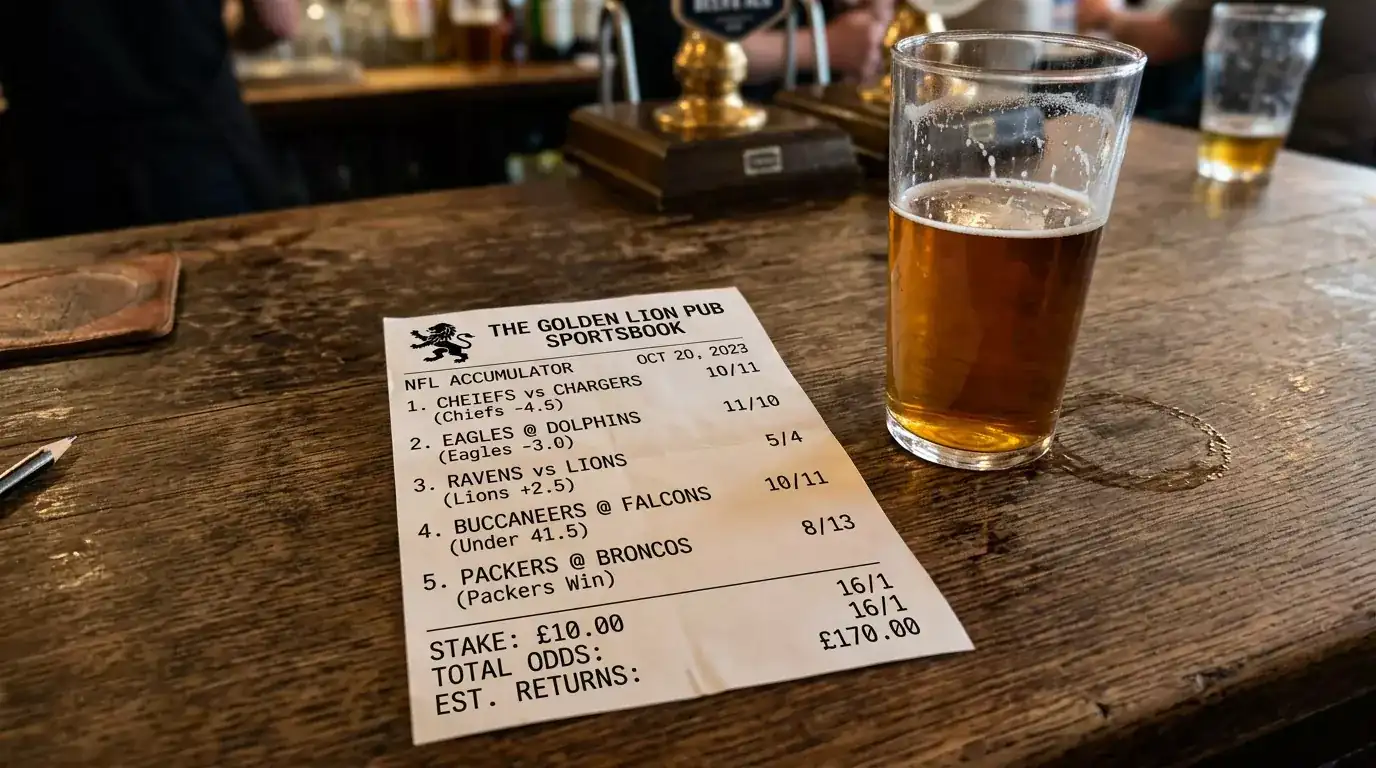
The flat-stake approach works because the NFL season is long enough for edge to manifest. You have 18 weeks of regular season, plus playoffs. At four to five bets per week, that is 72 to 90 bets. A 55% win rate at 10/11 odds produces a return on investment of roughly 5% over that sample. Small per-bet, meaningful over a season – but only if your bankroll survives the inevitable losing runs.
Two rules I enforce ruthlessly: never bet with money allocated for something else, and never reload the bankroll mid-season. If I burn through the entire amount, the season is over for me. That constraint forces discipline better than any app or tool ever could. It is the financial equivalent of a circuit breaker – a hard stop that prevents catastrophic loss.
Some punters prefer the Kelly Criterion – a formula that sizes bets proportionally to your perceived edge. The theory is sound: bet more when your edge is larger, less when it is smaller. In practice, it requires accurate estimation of your edge on every single bet, which is nearly impossible in the NFL. Overestimate your edge by even a small amount, and Kelly sizing leads to wild swings. For most UK bettors, the simplicity and stability of flat staking outperforms the theoretical optimality of Kelly by a wide margin. Save the mathematical elegance for conversations at the pub; in the real world, consistent sizing keeps you solvent.
One more point on bankroll: separate your NFL bankroll from any other sports betting you do. If you also bet on football, tennis, or horse racing, each should have its own pot. Mixing funds makes it impossible to evaluate whether your NFL strategy is profitable on its own – and if you cannot measure it, you cannot improve it.
Line Shopping Across UK Bookmakers
If bankroll management is the foundation, line shopping is the lowest-effort, highest-impact habit you can build. The concept is simple: before placing any NFL bet, check the odds at three or four UK bookmakers and take the best available price. The execution takes two minutes per bet. The cumulative effect over a season is worth several percentage points of ROI.
William Hill accounts for 37.83% of PPC clicks in UK sports betting; bet365 sits at 16.2%. Market share does not equal best odds. I have tracked NFL spread pricing across six UK operators for three consecutive seasons, and the variation on the same game can reach a full point on the spread and 10-15% on the implied probability for moneyline bets. Taking -3.0 instead of -3.5 on a single game might not feel significant. Over 80 bets in a season, those half-points compound into a measurable edge. A more detailed breakdown of NFL line shopping for UK punters covers the mechanics, tools, and timing in depth.
Schedule and Rest Advantages in the NFL
The NFL schedule is not random – it is a meticulously engineered 18-week puzzle designed for television. That engineering creates predictable structural advantages. Teams coming off a bye week are rested, prepared, and historically profitable against the spread. Teams playing on a short week (Thursday Night Football after a Sunday game) are physically compromised and tactically limited by reduced preparation time. These patterns recur every season because they are driven by physiology, not matchup quality.
The market knows about these edges and partially prices them in. But “partially” is the key word. Bye-week teams still cover at a rate slightly above 50% after the spread adjustment, and Thursday-night road teams on short rest remain consistently underperforming. The edge is thin – this is not a cheat code – but over a season of identifying and exploiting these spots, it adds up. For a granular analysis of rest edges, bye weeks, and travel-related advantages, the dedicated guide has the historical data.
Using DVOA, Red Zone Efficiency, and ATS Records
Win-loss records lie. A team that goes 10-7 against a weak schedule might be fundamentally worse than a 7-10 team that played the league’s toughest opponents. NFL betting demands metrics that measure performance independent of results – and the gold standard is DVOA (Defense-adjusted Value Over Average), developed by Football Outsiders.
DVOA measures every play’s success relative to the league average, adjusted for opponent quality, game situation, and down-and-distance. A team with a 15% offensive DVOA is performing 15% better than average on offence after all adjustments. Football accounts for roughly 34% of all US sports betting handle, and the sharpest bettors in that market live inside DVOA splits. Red zone efficiency, third-down conversion rates, and ATS (against-the-spread) records are equally important filters. The full breakdown of which NFL stats actually predict betting outcomes covers how to source, interpret, and apply these metrics from the UK.
Weather, Travel, and Situational Factors
Weather is the most underrated factor in NFL betting for UK punters, partly because we tend to underestimate how extreme American weather gets. A December game at Lambeau Field in Green Bay might have a wind chill of -15 degrees Celsius with 30 mph gusts. That is not “cold” in the way a January match at Burnley is cold – it is genuinely debilitating for passing offences, kicking accuracy, and ball security.
Wind above 15 mph suppresses passing volume and accuracy. Temperature below -5 degrees Celsius affects grip and ball flight. Rain and snow slow offensive tempo and increase turnover probability. All of these factors push totals down and create value on unders. I check weather forecasts for every outdoor NFL game before placing totals bets – it takes 60 seconds per game and has been one of my most reliable edge sources on over/under markets.
Travel is subtler but real. An East Coast team flying to the West Coast for a 1 PM Pacific kickoff (which is 4 PM in their body clock) faces a circadian disadvantage. The reverse trip – a West Coast team playing a 1 PM Eastern start (10 AM body clock) – is even worse. These are not theories; they are measurable patterns in historical ATS data. Cross-country travel after a Monday night game, with a short turnaround to the following Sunday, compounds the effect. I weight travel factors most heavily in Weeks 5 through 12, when accumulated fatigue intersects with schedule density.
Venue matters too. Dome teams travelling to outdoor stadiums in cold weather face a double disadvantage: they are unfamiliar with the conditions, and their offensive scheme is typically optimised for the controlled environment they play in 8-9 games per season. The reverse – an outdoor team playing in a dome – does not carry the same disadvantage, because playing in ideal conditions rarely hurts anyone. When I see a dome team at an outdoor venue in November or December with wind and precipitation in the forecast, the total almost always warrants a closer look at the under.
Avoiding Public Bias and Fading the Crowd
The night after a team loses a primetime game by 30 points, social media is full of takes. “They are finished.” “Fire the coach.” “Worst team in the league.” The following week, the bookmaker adjusts the spread to reflect public sentiment, and the beaten team opens as a bigger underdog than their underlying performance warrants. This is the public bias cycle, and it is one of the most consistent edges in NFL betting.
Public money – the aggregate of casual bettors who follow narratives rather than data – flows toward teams that looked good last week and away from teams that looked bad. The market does not follow public money blindly; bookmakers are sophisticated operators who balance their books through line movement. But the line still moves, and when it overshoots, contrarian value appears on the other side.
Fading the public is not the same as always betting the opposite of popular opinion. It means recognising when public sentiment has pushed a line beyond fair value and exploiting the gap. I track this by watching line movement patterns: when a spread opens at -3.0 and moves to -4.5 without any injury news or significant information change, the movement is likely public-money driven. If my model still says the game is a -3.0 game, the team getting +4.5 has an extra 1.5 points of value.
Bill Miller, the President and CEO of the American Gaming Association, has described legal sports betting as a way for fans to “enhance the fun and friendly competition that make NFL games and traditions even more special.” He is right – for casual bettors, that engagement is the product. For analytical bettors, that casual engagement creates the pricing inefficiencies we exploit. The more money flows in from emotion-driven punters, the more opportunity exists for process-driven ones.
One caveat: fading the public works best in high-profile, nationally televised games where casual betting volume is highest. Thursday Night Football, Sunday Night Football, Monday Night Football, and playoff games attract disproportionate public money. The 1 PM Sunday games with two mid-table teams generate far less public attention and correspondingly fewer narrative-driven mispricings. Focus your contrarian analysis where the crowds are, not where they are not.
When to Bet: Early Lines, Steam Moves, and Closing Value
Timing is not everything in NFL betting, but it is close. The same bet placed on Tuesday evening and Saturday morning can differ by a full point on the spread – and that full point, over a season, is the difference between profit and loss.
NFL opening lines typically appear on Sunday evening or Monday morning (UK time) for the following week’s games. These lines reflect the bookmaker’s raw power ratings before any significant public money has landed. By Wednesday, injury reports start filtering in and the lines adjust. By Friday, the bulk of recreational money has arrived and the lines have shifted to reflect public sentiment. Saturday brings final injury designations and the last wave of sharp money that pushes lines toward their closing value.
The question of when to bet depends on which side you are on. If you are backing a team that the public will also back, bet early – before public money pushes the line against you. If you are fading a popular team, bet late – let the public money move the line in your favour, then take the inflated number.
Steam moves deserve special attention. A steam move is a sudden, sharp line change driven by coordinated sharp money landing simultaneously at multiple sportsbooks. If a line moves from -3.0 to -4.0 across three UK operators within 15 minutes, that is a steam move. Following steam moves can be profitable because they signal where informed money is going – but you need to catch them quickly. By the time you notice the move, the best of the value may already be gone. Setting up odds alerts on your sportsbook apps can help you spot these movements in near-real time.
Closing line value – the difference between the odds you got and the odds at kickoff – is the single best measure of whether your timing is working. If you consistently beat the closing line (getting better odds than the final market price), you are making money long-term, even if short-term results are choppy. If you consistently get worse odds than the closing line, your timing is costing you, regardless of your win rate.
One practical approach I have found effective: set specific windows for placing bets. I do my analysis on Monday and Tuesday, place any early-value bets on Tuesday evening, then revisit on Saturday afternoon after final injury designations are released. This two-window system gives me a shot at early-line value on one end and maximum information on the other. The midweek period – Wednesday through Friday – I largely avoid, because the lines are in transition and the information picture is incomplete. Having a routine prevents impulse betting, which is where most recreational punters leak the most money.
Tracking Your Bets and Measuring ROI
If you are not tracking your bets, you do not have a strategy – you have a hobby. Tracking transforms NFL betting from a series of isolated decisions into a data set you can analyse, learn from, and refine.
My tracking spreadsheet has nine columns: date, game (teams and week), market (spread/moneyline/total), selection, line (the spread number or total), odds (fractional), stake, result (W/L/P), and closing line. That last column is the one most punters skip, and it is the most valuable. Comparing your odds to the closing line tells you whether your timing added or subtracted value – a diagnostic that no amount of result-tracking alone can provide.
After every four-week block, I review the data. Not individual bets – aggregates. What is my win rate on home underdogs? On road favourites of more than seven points? On totals in outdoor games? On Thursday night games? Patterns emerge that I would never spot by memory alone. Two seasons ago, I discovered that my win rate on NFL totals was 59%, while my sides (spread) win rate was 52%. The data told me to lean harder into totals and reduce my sides volume. That single adjustment improved my season ROI by nearly two percentage points.
The UK has 2,262 licensed betting operators, and with so many options, it is easy to scatter bets across platforms and lose track of the overall picture. Centralise your records. Whether you use a spreadsheet, a dedicated app, or a notebook, the discipline of recording every bet immediately after placing it is what makes the whole system work. Skip it, and you are flying blind.
Beyond the raw numbers, tracking forces accountability. It is easy to remember your best wins and conveniently forget the losses. A tracking record does not let you lie to yourself. After 200 bets, your true win rate, average odds, and ROI are there in black and white – and that honesty is what drives genuine improvement. The punters I have seen make the biggest leaps in profitability are not the ones who found a magic system; they are the ones who started measuring what they were already doing and cutting out the approaches that were not working. Whether you are a beginner or a seasoned punter, Best bet for nfl provides all the expert picks and analysis you need for the upcoming season.
FAQ
What is the best bankroll strategy for NFL betting in the UK?
A flat-stake approach using 2-3% of your starting bankroll per bet is the most reliable long-term strategy. Set your NFL bankroll at the start of the season as money you can afford to lose, size every bet as a fixed percentage of that starting amount, and never reload mid-season. This approach survives losing streaks and lets your edge compound over 80-plus bets.
How do rest days and bye weeks affect NFL betting outcomes?
Teams coming off a bye week historically cover the spread at a slightly higher rate than average, thanks to additional preparation time and physical recovery. Teams playing on short rest – particularly Thursday Night Football after a Sunday game – tend to underperform against the spread. These edges are small but consistent across multiple seasons.
What are the most important NFL stats to check before placing a bet?
DVOA (Defense-adjusted Value Over Average) is the most comprehensive single metric for evaluating team quality. Red zone efficiency, third-down conversion rates, and against-the-spread records provide additional context. Weather forecasts for outdoor games and injury reports round out the pre-bet checklist. Free sources like Football Outsiders and Pro Football Reference cover most of these metrics.
Prepared by the Best bet for nfl editorial staff.