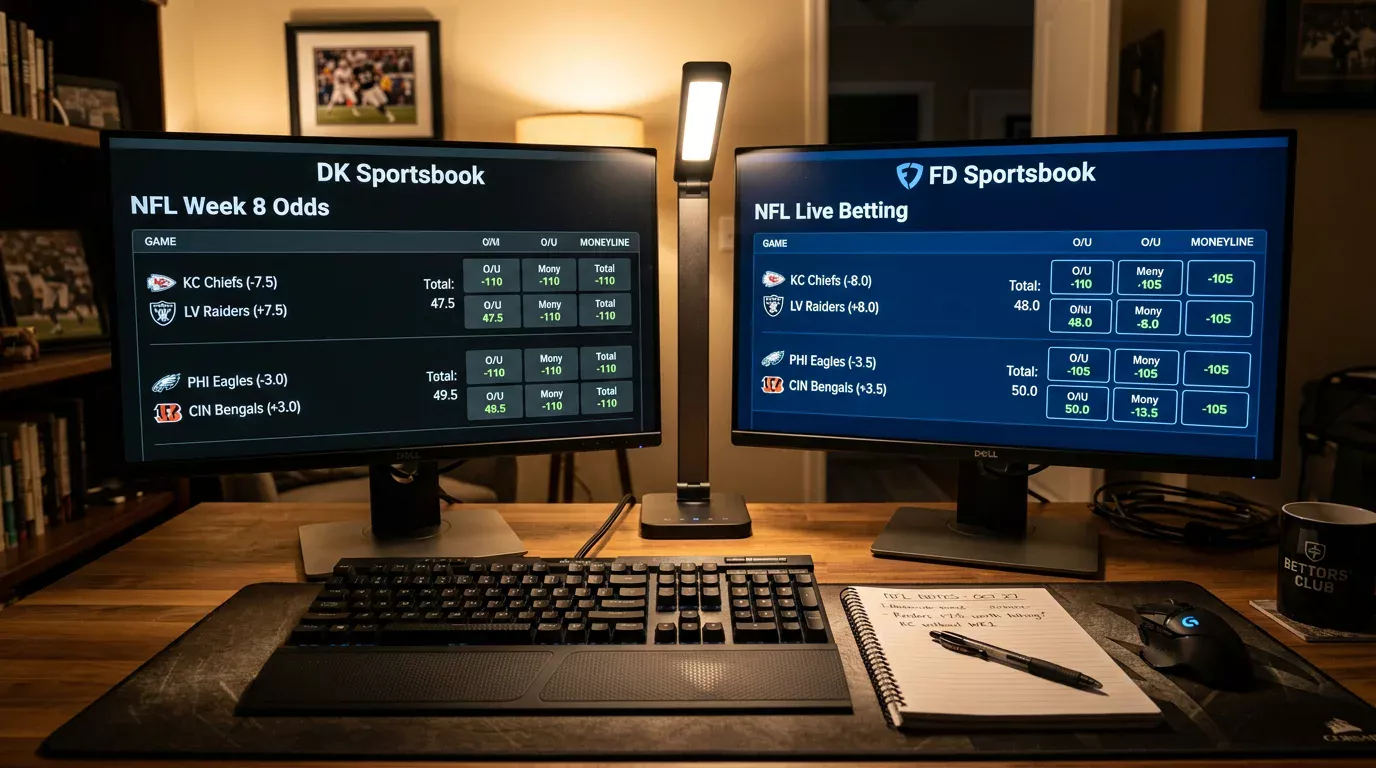
NFL Key Numbers in Spread Betting: Margins of Victory
 Available in US
I lost a bet by exactly three points on a Monday night in November 2021, and instead of cursing the result, I pulled up five years of NFL final score data. What I found reshaped how I approach every spread bet: NFL games land on certain margins of victory with disproportionate frequency, and the number three isn’t just common — it’s the single most powerful number in American football betting. Understanding key numbers is the closest thing to a structural edge that exists in NFL spread markets.
If you’ve been betting NFL spreads at UK bookmakers and wondered why the difference between -2.5 and -3.5 feels like it matters more than the difference between -5.5 and -6.5, you’re already intuiting the concept. Key numbers are specific margins of victory that occur far more often than probability alone would predict, because of how NFL scoring works. A field goal is worth three points. A touchdown plus extra point is worth seven. Those two numbers — and their multiples — dominate the distribution of final margins in ways that directly affect your spread betting results.
Statistical Importance of NFL Key Numbers
Every sport has its scoring DNA. In football, goals are worth one — margins cluster around 1, 2, and 3. In rugby, the mix of tries, conversions, and penalties creates certain recurring margins. NFL’s scoring DNA is uniquely concentrated. American football accounts for about 34% of all US sports betting handle, and a huge proportion of the analytical edge in that market traces back to understanding these scoring patterns.
Three is the king of key numbers. A field goal — the most common scoring play in the NFL — is worth exactly three points. Games decided by a single field goal finish with a margin of three. Over the past decade, approximately 15% of all NFL games have been decided by exactly three points. No other single margin comes close to that frequency.
Seven is the second key number. A touchdown (six points) plus the nearly-automatic extra point (one point) equals seven. Games decided by a converted touchdown finish at a margin of seven. Historically, about 9-10% of games land on exactly seven.
Ten — a touchdown plus a field goal lead — is the third key number, showing up as the final margin in roughly 6-7% of games. Six (two field goals or a touchdown without an extra point) and fourteen (two touchdowns) round out the secondary key numbers, each appearing about 4-5% of the time.
These frequencies dwarf what a random distribution would predict. If margins were evenly distributed between 1 and 30, each would occur roughly 3.3% of the time. Three occurring at 15% is four to five times the expected rate. That concentration is what makes key numbers actionable for betting.
Margin-of-Victory Distribution: How Often Games Land on 3 and 7
I built a spreadsheet three years ago that tracks every NFL game’s final margin, and I update it religiously each week during the season. The patterns are remarkably stable year over year — the percentages fluctuate by a point or two, but the rank order almost never changes.
In a typical NFL season of 272 regular-season games, you can expect approximately 40-42 games to finish with a margin of exactly three. Another 25-28 will land on seven. Roughly 16-18 on ten. And about 12-14 on six. Together, these four key numbers account for nearly 35% of all games. That means more than one in three NFL games ends on a key number.
For spread bettors, the practical implication is this: the value of a half-point is not constant across all spread values. Moving from -3.5 to -3 (or from +3 to +3.5) captures a disproportionate chunk of outcomes because you’re crossing the single most common margin of victory. The same half-point adjustment from -5.5 to -5 is less impactful because five is not a key number — it occurs as a final margin far less frequently.
Here’s a useful mental map. When a spread sits at 3, ask yourself: am I comfortable with a push (where you get your stake back) on the most common margin, or do I want to be on the right side of it? When a spread sits at 7, the same question applies with slightly lower frequency but similar strategic weight. At any other number — 4, 5, 8, 9 — the half-point matters less because those margins are distributed more evenly.
Buying Points Around Key Numbers: When It’s Worth the Juice
Most UK bookmakers offer alternate spread lines where you can buy or sell half-points for adjusted odds. This feature is specifically designed around key numbers, and knowing when to use it is one of the highest-value skills in NFL spread betting.
The standard trade is moving a spread from -3.5 to -3 (or +2.5 to +3). This half-point purchase typically costs around 15-20 cents of juice in American odds terms, which translates to moving from roughly 10/11 to about 5/6 on a fractional basis. Is that cost worth it? The maths says yes — emphatically. Because roughly 15% of games finish on a margin of exactly three, buying across the three captures value that far exceeds the additional price paid.
Contrast that with buying from -6.5 to -6. Six is a semi-key number (4-5% occurrence), so the value of that half-point is roughly one-third of buying across the three. Yet bookmakers often charge a similar juice adjustment. The cost-benefit ratio is unfavourable. I virtually never buy half-points at non-key numbers unless there’s a specific game-level reason to believe the margin will cluster around that exact figure.
My personal rule: always consider buying through three, usually consider buying through seven, and almost never buy through any other number. William Hill leads the UK market in PPC click share at 37.83% — meaning they’re the most visible bookmaker in search results — but visibility doesn’t equate to the best alternate-line pricing. I routinely check three or four platforms to find the sharpest price on key-number buydowns.
Alternate Spreads and Key-Number Arbitrage
Beyond simple half-point purchases, alternate spread markets at UK sportsbooks open up more sophisticated key-number strategies. An alternate spread lets you select a spread significantly different from the market line — backing a -7 favourite when the market line is -3, or taking an underdog at +10 instead of the standard +3.5.
The value play here involves understanding how bookmakers price these alternates relative to the key-number distribution. A team favoured by 3 on the standard line might be available at -7 for a price around 2/1 or higher. If you believe that team will win comfortably, the alternate spread offers a way to express that conviction with a corresponding payout — rather than laying -3 at 10/11 and collecting a modest return regardless of whether they win by 3 or by 30.
Conversely, alternate spreads on underdogs can provide cushion across multiple key numbers. Taking +10 on a team whose standard line is +3 means they can lose by up to nine and you still cash. You’re crossing through three, six, seven, and ten — capturing a significant chunk of the margin distribution. The odds will be compressed (perhaps 1/3 or shorter), but as part of a broader NFL spread betting strategy, these compressed-odds alternate spreads can function as high-probability legs in accumulators.
The arbitrage opportunity — and it’s narrow — comes from comparing alternate-line pricing across bookmakers. Because different platforms model key-number distributions slightly differently, you can occasionally find meaningfully different prices on the same alternate spread. A -7 alternate at 9/4 on one platform versus 2/1 on another represents genuine value for the same outcome. These gaps are small and close quickly, but they exist consistently enough to reward punters who check multiple sportsbooks before placing key-number-related bets.
Why is 3 the most important key number in NFL betting?
Three is the most important key number because a field goal — the most common scoring play in the NFL — is worth exactly three points. Approximately 15% of all NFL games finish with a margin of exactly three points, making it by far the most frequent final margin. This concentration means the difference between a spread of -2.5 and -3.5 carries more weight than any other single half-point adjustment.
Should I buy a half-point on NFL spreads?
Buying a half-point is most valuable when crossing through key numbers, particularly three and seven. Moving from -3.5 to -3 captures roughly 15% of game outcomes and is almost always worth the additional juice. Buying through non-key numbers like 5 or 8 offers less value relative to cost. Check alternate-line pricing at multiple UK bookmakers to find the best terms for point purchases.
Published by the Best bet for nfl team.