
NFL Betting Odds: Reading Fractional and Decimal Formats
 Available in US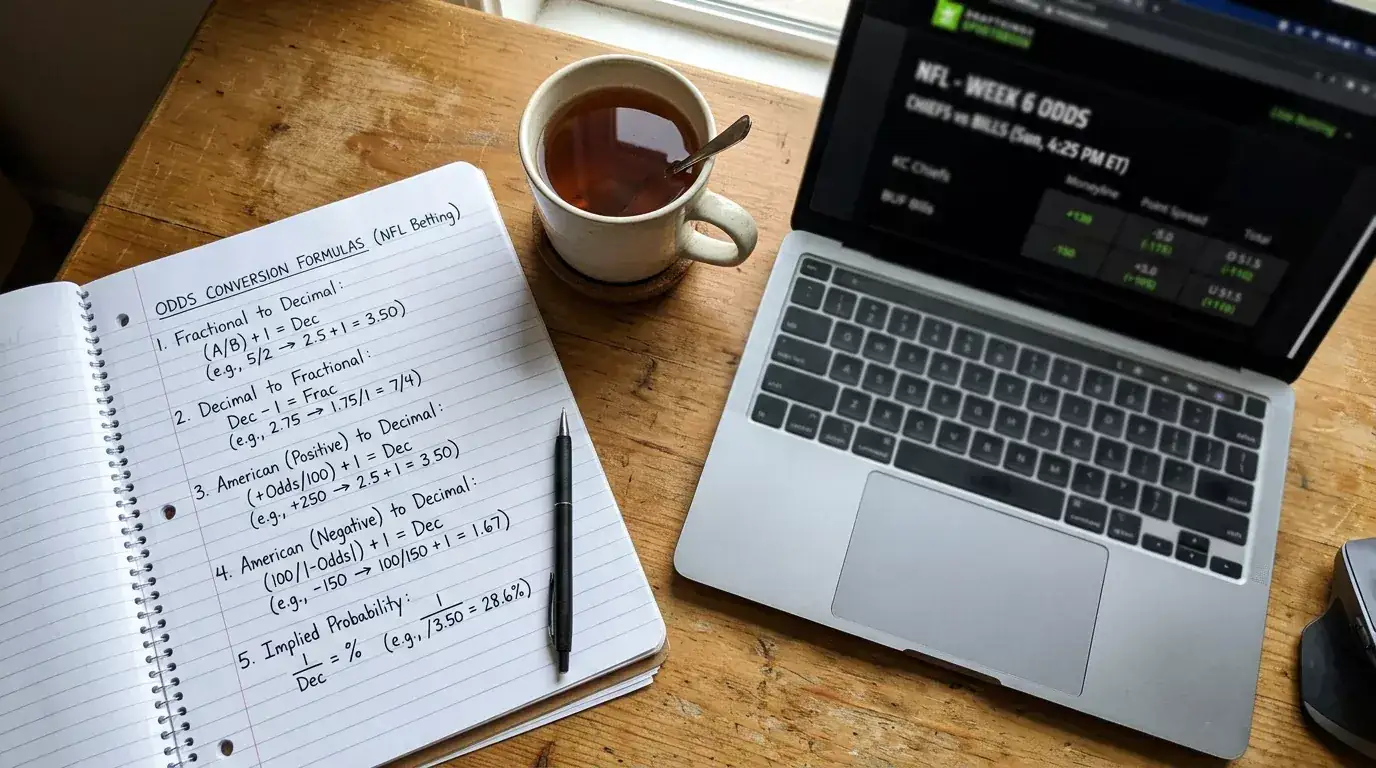
The first time I tried to follow NFL betting advice from an American podcast, I spent ten minutes trying to work out what “-110” meant. The host was rattling off numbers like everyone in the room understood American odds natively, and I sat there converting in my head while the conversation moved on. That frustration eventually became one of my most useful skills: I can now glance at any odds format and instantly know the implied probability, the payout, and whether the price offers value. This guide will get you there too.
Odds are the language of betting. Every sportsbook communicates the same information — how likely an outcome is and what you’ll be paid if it happens — but they express it in different formats depending on the market. UK bookmakers default to fractional. European platforms prefer decimal. American sportsbooks use their own plus/minus system. If you’re betting on NFL from the UK but consuming analysis from US sources, you’ll encounter all three formats regularly. Understanding each one, and being able to convert between them, is a foundational skill that separates punters who compare prices effectively from those who rely on a single bookmaker’s numbers.
Fractional NFL Odds: The UK Wagering Standard
If you’ve ever walked past a betting shop window in any British high street, you’ve seen fractional odds. They’re as native to UK betting culture as tea to the morning routine. And for NFL betting, they’re the format you’ll see first at every UKGC-licensed platform.
Fractional odds express the ratio of profit to stake. Odds of 3/1 (read “three to one”) mean you profit three pounds for every one pound staked. Odds of 1/4 (“one to four” or “four to one on”) mean you profit one pound for every four staked. The numerator is your potential profit; the denominator is the stake required to earn it.
Where it gets interesting for NFL is the range. Football matches in the Premier League routinely produce fractional odds in familiar territory — 6/4 for a home win, 5/2 for a draw, 2/1 for an away win. NFL moneyline odds, by contrast, often feature heavier favourites because draws essentially don’t exist. You’ll regularly see NFL favourites priced at 2/7, 1/5, or even 1/10 — short prices that UK punters more commonly associate with horse racing than team sports. Getting comfortable with these compressed fractions is part of adapting to NFL betting.
A quick mental shortcut I use: if the first number is smaller than the second (1/3, 2/5), you’re looking at a favourite. If the first number is larger (5/2, 7/1), it’s an underdog. Equal numbers (evens, or 1/1) mean the bookmaker considers the outcome roughly a coin flip before margin.
Decimal Odds: The European Alternative
I switched my default odds display to decimal about four years ago, and I haven’t looked back. Not because fractional odds are bad — they’re perfectly functional — but because decimal odds make comparison and calculation faster, especially when you’re evaluating multiple markets across different bookmakers.
Decimal odds represent the total return per unit staked, including the original stake. Odds of 3.00 mean a one-pound bet returns three pounds total — two pounds profit plus your one pound back. Odds of 1.50 mean you get back one pound fifty on a one-pound bet — fifty pence profit. The calculation is always the same: multiply your stake by the decimal odds to get your total return.
The advantage for NFL betting is in parlays. When building accumulators, decimal odds let you multiply each leg’s price together instantly to get the combined decimal odds. Try doing that quickly with fractional odds like 4/6, 10/11, and 8/13 — it requires converting to decimals first anyway. Most UK bookmakers let you toggle between formats in your settings, and I’d recommend switching to decimal for any session where you’re comparing prices or building multi-leg bets.
The UK sports betting market generates approximately 2.48 billion pounds in annual gross gambling yield, and a growing share of that comes from punters who are increasingly comfortable with decimal pricing, partly driven by the rise of exchange betting and European-facing platforms. If you’re already used to decimals from Betfair or other exchanges, applying them to NFL is seamless.
American Odds: Reading Lines from US Sources
This is the format that trips up most UK punters, and honestly, it tripped me up for longer than I’d like to admit. American odds use a plus/minus system anchored to a baseline of 100, and once the logic clicks, it’s actually quite elegant — just unfamiliar.
Negative numbers indicate favourites. A price of -150 tells you how much you need to stake to profit 100 units. So -150 means staking 150 to profit 100. The higher the negative number (-300, -500), the heavier the favourite. Positive numbers indicate underdogs. A price of +200 tells you how much you profit on a 100-unit stake. So +200 means staking 100 to profit 200. The higher the positive number, the bigger the underdog.
The baseline of 100 is the key that unlocks the system. Favourites: how much do I risk to win 100? Underdogs: how much do I win if I risk 100? Once you internalise that framing, American odds become readable at a glance.
Why does this matter for UK punters? Because the best NFL analysis — podcasts, analytics sites, Twitter threads from sharp bettors — comes predominantly from American sources. They quote American odds almost exclusively. If you can’t read -110, +140, or -250 fluently, you’re either doing mental maths constantly or missing context entirely. I’d estimate that 80% of the NFL betting analysis I consume uses American odds, and being literate in the format has been worth more to my betting than any single strategy I’ve learned.
Converting Between Formats: Quick Formulas and Examples
I keep a small conversion cheat sheet on my phone — not because I can’t do the maths, but because speed matters when a line is moving and you’re comparing prices across three sportsbooks simultaneously. Here are the formulas, followed by the worked examples that actually stick in your head.
Fractional to decimal: divide the fraction and add 1. So 5/2 becomes (5 / 2) + 1 = 3.50. And 4/9 becomes (4 / 9) + 1 = 1.44.
Decimal to fractional: subtract 1, then express as a fraction. So 2.75 becomes 1.75, which is 7/4. And 1.40 becomes 0.40, which is 2/5.
American to decimal: for positive odds, divide by 100 and add 1. So +250 becomes 3.50. For negative odds, divide 100 by the absolute value and add 1. So -200 becomes (100 / 200) + 1 = 1.50.
Decimal to American: if the decimal is 2.00 or higher, subtract 1 and multiply by 100 to get the positive American odds. So 3.00 becomes +200. If below 2.00, divide 100 by (decimal minus 1) and make it negative. So 1.50 becomes -100 / 0.50 = -200.
The conversions you’ll use most often for NFL: -110 = 1.91 = 10/11 (the standard vig line). +100 = 2.00 = evens. -150 = 1.67 = roughly 4/6. +150 = 2.50 = 6/4. -300 = 1.33 = roughly 1/3. +300 = 4.00 = 3/1. Europe holds the largest share of the global sports betting market — about 44% — and this cross-format fluency is increasingly essential as UK punters access NFL content from both American and continental European sources.
From Odds to Implied Probability: Calculating Your Edge
Every odds format is just a different way of expressing the same underlying number: implied probability. And implied probability is where the real analytical work begins.
The formula using decimal odds is the simplest: implied probability equals 1 divided by the decimal odds, expressed as a percentage. So decimal 2.00 implies a 50% chance. Decimal 1.50 implies 66.7%. Decimal 4.00 implies 25%.
For fractional odds: denominator divided by (numerator plus denominator). So 3/1 implies 1 / (3 + 1) = 25%. And 4/7 implies 7 / (4 + 7) = 63.6%.
Once you can convert any odds format to implied probability, you can do two things that most punters never do. First, calculate the overround: add up the implied probabilities of all outcomes in a market. A two-way NFL moneyline market where both sides are priced at 10/11 (implied probability 52.4% each) totals 104.8%. That 4.8% is the bookmaker’s margin — their built-in edge. The lower the overround, the better the value for you.
Second — and more importantly — compare the bookmaker’s implied probability to your own assessment. If you believe a team has a 45% chance of winning and the moneyline implies only 35%, the difference between your number and the market’s number represents your perceived edge. Over hundreds of bets, consistently finding situations where your assessed probability exceeds the implied probability is what generates long-term profit. The odds format is just packaging. The probability is the substance.
Which odds format is most common for NFL betting in the UK?
Fractional odds are the default format at UKGC-licensed bookmakers and what most UK punters see first when opening NFL markets. However, nearly all UK sportsbooks allow you to switch between fractional, decimal, and American formats in your account settings. Decimal is increasingly popular among bettors who build parlays or compare prices across platforms.
How do I convert American odds to fractional?
For positive American odds like +200, divide by 100 to get the fractional numerator over 1, giving 2/1. For negative odds like -150, put 100 as the numerator and the absolute value as the denominator, giving 100/150, which simplifies to 2/3. An online converter or the toggle in your bookmaker’s settings can speed this up during live betting.
Written by the editors at Best bet for nfl.